From Marble Halls to Glass Boxes: A Century of American Civic Architecture in Seven Buildings
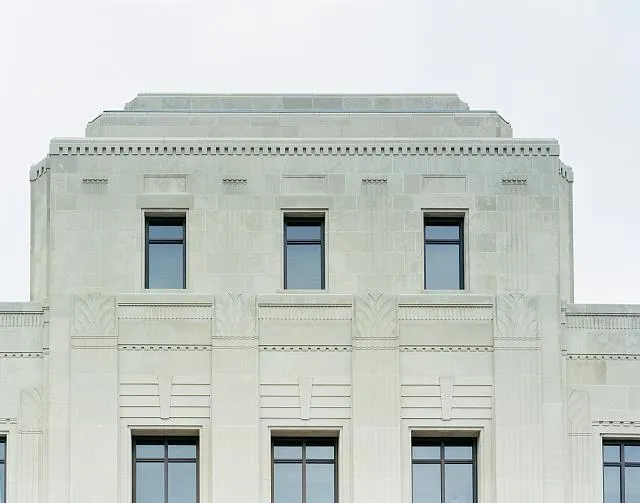
Photo: Carol M. Highsmith, Public domain, via Wikimedia Commons
Architecture critic Ada Louise Honce once observed that a courthouse tells you exactly how much a community fears its own government. She might have added: and how much it fears the public. Across a century of American civic building, the pendulum has swung from imperial reassurance to defensive withdrawal to, most recently, a cautious attempt at openness — and each swing is legible in stone, concrete, and glass.
1. The Beaux-Arts Assertion: New York County Courthouse, New York (1927)
The hexagonal marble temple on Foley Square announces nothing so much as certainty. Corinthian columns, a guilloche frieze, a bronze entrance meant to inspire awe rather than welcome. In the 1920s, civic architecture's job was to make government look permanent and superior — an architecture of reassurance aimed at an immigrant public presumed to need convincing.
2. The Depression-Era Dignity: Minneapolis City Hall and Hennepin County Courthouse (completed 1906, but its Art Deco interiors define the era's later mood)
By the 1930s, the grand rotunda and the cathedral-like atrium served a different function: dignifying public work during economic catastrophe. The message shifted from empire to service — government as the steady hand. The 30-foot 'Father of Waters' statue in the rotunda remains one of the most unabashedly monumental tributes to the Mississippi ever carved.
3. The Midcentury Optimist: Boston City Hall (1968)
Few buildings divide opinion like Kallmann McKinnell & Knowles' brutalist landmark. Its concrete cantilevers were intended as a democratic gesture — an open, cantilevered mayor's office hovering above a brick plaza where citizens could literally gather beneath their government. What read as transparency in renderings read as menace in weather. The building survived repeated demolition threats and a generation of criticism to earn landmark status, a reminder that public taste and public architecture operate on different clocks.
4. The Fortress Era: Federal Courthouses of the 1990s
Following the 1995 Oklahoma City bombing, federal design standards transformed dramatically. Courthouses across the country sprouted bollards, setbacks, blast-rated glazing, and blank walls at street level. The architecture of fear produced genuinely fortified buildings — functional, defensible, and, critics argued, corrosive to the very civic intimacy they were meant to house. The setback plaza became the era's signature: a moat of empty paving.
5. The Reopening: Salt Lake City Federal Courthouse (2014)
Thomas Phifer's glass tower represented a deliberate counterargument. A single, crystalline volume, it traded fortress mass for daylight and legibility — with security achieved invisibly through engineering rather than expressed through mass. It asked a pointed question: must safety look like fear?
6. The Civic Commons: Austin Federal Courthouse (2012)
Designed with a porous, sculptural facade and generous public ground floor, the Austin project treated the courthouse as a piece of urban fabric rather than a secure object in it. Its louvered skin mediates Texas sun while giving the building a texture that invites rather than repels — civic architecture as good neighbor.
7. The Digital-Era Question: The Courthouse Not Yet Built
The newest civic projects — remote hearings, digital filing, reduced physical traffic — raise an unresolved design problem. If fewer citizens need to physically enter a courthouse, what remains of its architectural purpose? Early answers favor hybrid programs: courthouses that double as emergency operations centers, community rooms, and after-hours civic space, keeping the building useful to the public it serves even when court is not in session.
What Should the Next Building Say?
Read as a sequence, these seven buildings chart a curve of trust: high and asserted, then eroded, then defensively withdrawn, then cautiously restored. The next generation of city halls and courthouses will be designed by architects facing the same question their predecessors did, with lower budgets and higher skepticism. The most convincing recent answer may be the simplest: buildings that admit daylight, admit the public, and admit — in their facades and their floor plans — that government is strongest when it has nothing to hide.